
Today we live a life where internet has become the basic necessity along with air, water, food and light. Human's life on the surface of earth has totally been changed in the past couple of decades. There is exponential rise in the ever demanding data transfer capacity in the form of internet. Initially electronic communication and data transfer was relying only in copper and then on wireless electromagnetic systems. Copper is actively dealing with transfer of electricity and data since 1820's and the invention of telegraphs. The invention of Telephone in 1876 created more demand for coppers. Today it is being used in ethernet connectivity, CATV transmissions, Voice and DSL based telephone connections and other short range communications with limited channel capacity. This limit is in terms of distance as well as data capacity.
An alternative solution for increasing the distance of data transfer capability as well as the amount of data to be transferred, Optical Fiber is the choice in place. Based on the principle of guiding the light by refraction first demonstrated by Daniel Colladon and Jacques Babinet in Paris in the early 1840s. Fiber optic cable is a material of glass and silica through which laser beam or light wave is passed. Traditional communication infrastructure in the local or core exchanges or server rooms is mostly based on copper wires and electrical signalling. Use of fiber is thus adapted from office to remotely located long distance areas as well as to connect cities and metro to long haul communication. Transducers to convert electrical signals into optical and vice versa are required at each terminal point within the fiber network. The rigidness, and physical strength the fiber cables are equipped, enables them to be deployed for a distance not less than hundreds of kilometers. The rigidness and toughness of these cables have allowed them to be used for telecommunication deployments around the glob, into the deep oceans and land based stations. The first submarine communication cable was laid in 1850's to carry telegraphic traffic. The fiber optic submarine cable has connected all the continents except Antarctica.

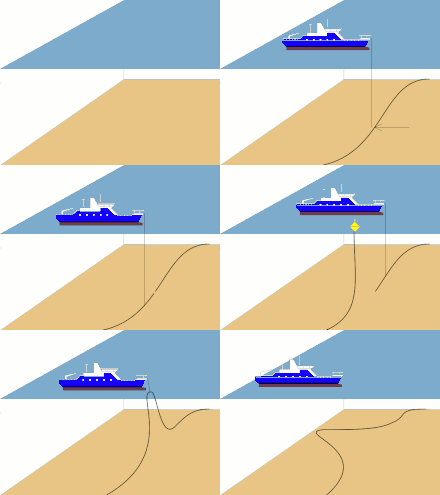
This is how submarine communication cable are repaired.
The traditional method of delivering high capacity data to metro as well as long haul links is through the use of SDH and WDM. Synchronous Digital Hierarchy and Wavelength Division Multiplexing take care of fiber based data communication to the whole network. In telecommunication terms this part of the network is referred as ''Transmission''. The central office is eqquiped with SDH and WDM racks along with oprical transmission mechanism while the distribution points have node to interface for desired data link to desired locations. Mostly designed to work in the form of rings to have geological distinct redundant routed work to reduce downtime in case of cable breakage.


SDH Network Visualized.
In order to meet ever increasing demand of data transfer from home, business and small corporate level a revolutionary field of FTTx using PON has emerged. Passive Optic Network has enabled domestic connections to enjoy the huge capacity of data transfer. The most important aspect is the features it offers in terms of low cost, reliablity, huge capacity which copper can never attain and above all the network is passive throughout the field. It doesn't need electric power and backup solutions to be active. PON is established using FTTx topology where 'x' can be 'H' for home, 'n' for node, 'c' for curb,'b' for building and 'o' for office. So fiber every where. Devices placed inside the customer's premises are ONT's while the central switch which deals with defined capacity of these connections is OLT placed at the central office or local exchange for a Telecommunication Company. FTTx utilized single mode fiber with three wavelengths, 1310nm for uplink, 1490nm for downlink and 1550nm for TV or Video transmission broadcast. The defined capacity of 1.25Gbps for each customer has allowed to deliver Video on Demand, HD TV brodcast, Special Private Data, Broadband Internet, Telephone, Video Surveillance, Security and many other futuristic services just on a single fiber link and a single device in the customer's home. This huge benefit of reliable wired communication links in a cost effective manner is rapidly consuming the telecom market.

PON with FTTx topology visualized.

No comments:
Post a Comment